
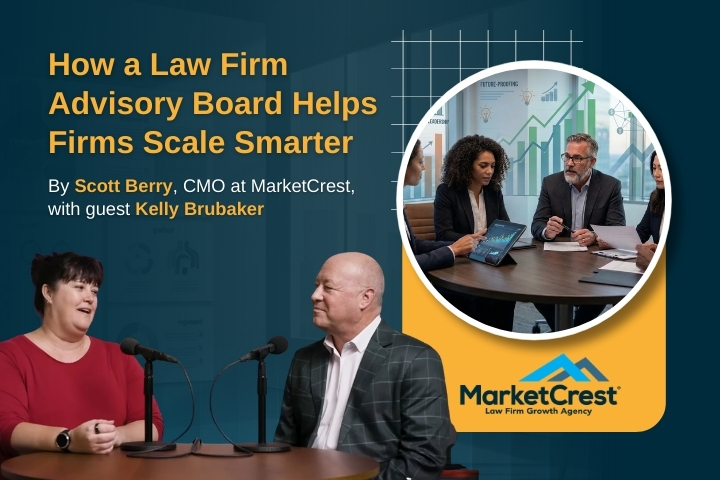
By Scott Berry, CMO at MarketCrest, with guest Kelly Brubaker, Fractional CFO/CPA at Profit Scale Thrive
Running a law firm shouldn’t feel like you’re coaching a championship team…alone. Yet most immigration and family law owners are calling every play with no trusted advisors in the room. This summary from one of our top episodes of The Law Firm Growth Lab breaks down how to fix that with one of the most underrated growth levers in the legal industry: a law firm advisory board.
Visit the Law Firm Growth Lab Podcast to listen to the whole podcast or continue reading to explore the key takeaways.
What is an Advisory Board?
An advisory board is a small group of trusted professionals who provide strategic guidance to a law firm owner. Unlike a board of directors, an advisory board has no legal authority over the firm and does not control decisions. Instead, its role is to offer experienced outside perspective, challenge assumptions, and help the owner think through important business choices. An advisory board is a practical, low risk way to improve decision-making ‑and scale your firm without giving up equity or control.
The Power Behind an Advisory Board
Law firm owners commonly feel the pressure of being the only one who “gets it.” Advisory boards break that isolation in three major ways:
First, they reduce risk. A board helps you vet decisions, spot blind spots, and filter out bad advice; especially the kind that sounds brilliant but isn’t grounded in financial reality or marketing math.
Second, they let you keep full control. Unlike taking on a partner, an advisory board gives you access to experience and strategic thinking without giving away equity or voting power.
Third, they replace lonely leadership with real support. Not everyone in your personal life understands the stress of running a growing law firm. Your advisory board does.
When marketing, finance, and operations perspectives converge, your decisions get sharper and your growth becomes far more predictable.
What an Advisory Board Actually Looks Like
An effective advisory board is small by design. Think three to four people who bring different strengths: someone financially minded, someone who thinks about growth and marketing, someone who understands operations, and ideally a business owner who has faced similar challenges.
What makes these people valuable is not their resume; it’s their independence. They aren’t “yes people.” They’re willing to push back, ask hard questions, and help you think more strategically than you would on your own. You can often find excellent advisors through local business circles, chambers of commerce, professional associations, or introductions from people you trust.
How to Structure Your Board
Start by meeting quarterly. It gives you time to execute between sessions while keeping you focused on priorities. Meetings work best in semi-private settings where you can speak candidly; restaurant back rooms and catered conference rooms work great.
To keep conversations productive, use a consistent meeting rhythm. Begin with what’s happened since the last meeting; wins, headline metrics, standout challenges; then narrow in on one or two key priorities you want help with.
End with clear commitments and deadlines. The legal protections are simple: an NDA and a short agreement clarifying that the board is purely advisory. You stay in full control.
What to Share (and What to Protect)
An advisory board only works when you’re transparent. That means sharing:
- High-level P&L numbers
- Lead and consult trends
- Intake conversion patterns
- Cash flow concerns
- Operational bottlenecks
Remove client data and sensitive personal information but give advisors the real business picture; they can only help at the level you’re willing to open up.
How Advisory Boards Keep You Focused
One of the biggest value drivers of an advisory board is how effectively it eliminates shiny object syndrome. Instead of chasing new tools, new programs, new practice areas, and new books, your board keeps you anchored to what matters most. You stay accountable to your quarterly priorities, and every decision gets filtered through strategy rather than impulse.
This is especially useful when marketing and finance must work together. You don’t want to expand ad spend without understanding Customer Acquisition Cost (CAC), and you don’t want to shut down marketing when you’ve misread cash flow. A board keeps both sides aligned.
Keep the Board Fresh
Advisory boards work best when they evolve with your firm. Consider term limits of 12 to 18 months. You don’t need to overhaul the whole board; just rotate in new voices periodically to avoid stagnation and bring new thinking into the room.
A 30-Day Plan to Launch Your Board
You can start a functional advisory board in one month:
Week 1: Clarify why your board exists, what success looks like, and which perspectives you need most.
Week 2: Identify 10–12 candidates and interview them to test fit, independence, and chemistry.
Week 3: Finalize advisors, complete NDAs, share key background information, and prepare a simple agenda.
Week 4: Run your first meeting, establish commitments, and schedule the next quarterly session.
Repeatable. Manageable. Transformational.
What to Track
You don’t need a dozen KPIs to run a board effectively. Focus on core categories:
- Topline revenue and trends
- Lead and consult flow
- Hire rate and client acquisition patterns
- CAC and marketing efficiency
- Cash position and margin strength
- Client experience signals (reviews, net promoter score (NPS), speed to lead)
This gives everyone a clear snapshot of your firm’s health without drowning anyone in data.
Final Thought
You can run your law firm on instinct, or you can run it on insight. One keeps you busy.
The other makes you unstoppable.
Build your board. Build your confidence. And build the practice you set out to create.
Want Help Standing Up Your Board?
MarketCrest, LLC works with law firms to connect marketing math with financial discipline so growth becomes predictable. If you’d like templates for NDAs, scorecards, your first meetin‑g agenda or help recruiting the right advisors; email “Board Kit” to scottberry@marketcrest.com and I’ll send the package.
Subscribe to The Law Firm Growth Lab for more conversations where growth becomes a science.